





Where to Charge Electric Scooters: The Ultimate Guide
Discover where to charge electric scooters, including home charging, public options, and portable chargers. Plus, tips for keeping your scooter charged and ready to go.
Electric scooter owners can charge their scooters in five primary locations: at home (most convenient, uses standard 110V wall outlet, 3-9 hour charge time depending on battery size), at work (requires employer permission, charges during 8-hour workday, increasingly common workplace amenity), at public charging stations (emerging infrastructure in major cities at shopping centers, parking garages, transit hubs, typically free or low-cost), at cafes and restaurants (courtesy charging while patronizing business, best for partial top-offs during 1-2 hour visits), and portable charging with backup batteries or solar panels (enables off-grid charging for extended trips, camping, or emergency situations). For rental scooter operations (Bird, Lime, Spin), charging follows different model where independent contractors called "chargers" or "juicers" collect scooters with depleted batteries (typically below 20%), transport them to residential charging locations overnight earning $3-12 per scooter, and redeploy fully charged scooters the next morning, while some operators use swappable battery systems where workers replace depleted batteries with pre-charged units in the field. This comprehensive 2024-2025 guide explains all scooter charging locations with practical details, how to find public charging stations using apps like PlugShare and ChargePoint, workplace charging etiquette and setup considerations, charging costs and electricity consumption (typically $0.10-0.40 per full charge), safety considerations for each charging location, how rental scooter charging operations work, and future charging infrastructure trends including dedicated scooter charging hubs and wireless charging technology.
Charging at Home: The Most Convenient Option
Home charging represents the primary charging location for 90%+ of private scooter owners, offering unmatched convenience and control.
Home Charging Setup Requirements
Electric scooters charge from standard household outlets with minimal setup:
- Standard 110-120V outlet: All electric scooters sold in US use chargers compatible with normal household outlets (no special 220V circuits needed like some EVs)
- Grounded three-prong outlet: Chargers require properly grounded outlets for safety (avoid using two-prong adapters)
- Dedicated circuit recommended: While not required, using outlet on dedicated 15-20 amp circuit avoids tripping breakers when other devices operating simultaneously
- Accessible location: Place scooter near outlet to avoid extension cord use (extension cords increase resistance and fire risk)
No special equipment needed: Unlike electric cars requiring Level 2 charging stations ($500-2,000 installation), scooters charge with included wall charger at no additional infrastructure cost.
Home Charging Process
Step-by-step home charging:
- Position scooter near outlet: Place on hard, non-flammable surface (concrete, tile, hardwood) rather than carpet
- Locate charging port: Usually on deck near stem or on stem itself, covered by rubber port cover
- Open port cover and connect charger: Insert charger plug firmly until click or full seating achieved
- Plug charger into wall outlet: Charger should indicate charging with LED (typically red = charging, green = full)
- Wait for full charge: Most scooters require 3-9 hours depending on battery size (ES2: 3.5 hours, Max G30: 6-9 hours)
- Disconnect when complete: Unplug from wall first, then disconnect from scooter
- Close port cover: Protect charging port from dust and moisture
Best Practices for Home Charging
Optimize safety and battery longevity with these practices:
- Charge overnight during off-peak hours: Takes advantage of lower electricity rates in time-of-use billing areas, allows full 8-hour charge window without monitoring
- Charge in garage, utility room, or outdoor covered area: Reduces bedroom fire risk, provides ventilation, isolates heat from living spaces
- Use timer for automatic shutoff: Set outlet timer to disconnect after expected charge duration (prevents leaving scooter plugged in for days)
- Charge in temperature-controlled environment: Optimal charging occurs at 50-86°F; avoid charging in freezing garage or hot direct sunlight
- Keep charger off flammable surfaces: Place charger on concrete, metal, or ceramic surfaces, never on carpet, wood furniture, or upholstery
- Create dedicated charging station: Designate corner of garage or utility room for scooter charging with clear floor space and accessible outlet
Home Charging Electricity Cost
Electric scooter charging costs far less than gasoline vehicles or even public transit.
Cost calculation:
Cost per charge = (Battery capacity in kWh) × (Electricity rate per kWh)
Example calculations at average US rate ($0.14/kWh):
- Xiaomi M365 (187Wh = 0.187kWh): 0.187 × $0.14 = $0.026 per charge (~3 cents)
- Ninebot Max (551Wh = 0.551kWh): 0.551 × $0.14 = $0.077 per charge (~8 cents)
- Apollo Pro (1,092Wh = 1.092kWh): 1.092 × $0.14 = $0.153 per charge (~15 cents)
- Dualtron Thunder (2,700Wh = 2.7kWh): 2.7 × $0.14 = $0.38 per charge (38 cents)
Monthly/annual costs for typical commuter:
Rider with 30-mile weekly commute on Ninebot Max (40-mile range, one charge per week):
- Weekly cost: $0.08
- Monthly cost: $0.32 (4 weeks)
- Annual cost: $4.16 (52 weeks)
Compare to: Car at 25 mpg and $3.50/gallon gas = $168/year for same 1,560 miles, bus pass = $900-1,200/year in most cities.
Multi-Scooter Household Charging
Households with multiple scooters (family of riders) need charging strategy:
- Stagger charging times: Charge one scooter 6pm-midnight, second midnight-6am to avoid overloading circuit
- Install additional outlets: Add second garage outlet on separate circuit for simultaneous charging ($150-300 electrician cost)
- Use power strip with surge protection: Allows charging multiple scooters from one outlet (verify circuit amperage adequate—two scooters drawing 3A combined = 6A total, well within 15A circuit capacity)
- Designate charging priority: Charge scooter with tomorrow's ride scheduled first, others as time permits
Charging at Work: Convenient for Daily Commuters
Workplace charging enables scooter commuting for distances beyond half-range, effectively doubling viable commute distance with midday charge.
Obtaining Workplace Charging Permission
Before plugging in at work, secure explicit permission from employer:
Approach to request workplace charging:
- Identify appropriate person to ask: Direct supervisor, facilities manager, HR department, or building management
- Emphasize minimal cost impact: Calculate charging cost ($0.08-0.15 per charge = $20-40 per year) to demonstrate negligible electricity expense
- Highlight environmental benefits: Frame as supporting company sustainability goals and reducing parking demand
- Propose specific charging location: Suggest break room outlet, parking garage corner, or outdoor bike rack area to show you've thought through logistics
- Offer to sign waiver: If company concerned about liability, offer to sign document accepting responsibility for equipment
- Reference other companies' policies: Many tech companies, universities, and progressive employers actively encourage scooter commuting with designated charging areas
Common Workplace Charging Locations
Where employers typically permit scooter charging:
- Break room or kitchen: Most common location, allows monitoring during lunch, convenient outlet access
- Personal office or cubicle: If you have assigned workspace with outlet, most convenient option
- Parking garage: Dedicated EV charging area may include outlets for micro-mobility (scooters, e-bikes), secure location reduces theft concern
- Bike storage room: Companies with bike commuter programs often provide indoor storage with outlets
- Mail room or storage area: Out-of-the-way location avoids high-traffic area congestion
- Outdoor covered area: Bike racks with weather protection and nearby outlets becoming more common
Workplace Charging Etiquette
Maintain good relationships with coworkers and employer:
- Don't monopolize outlets: If outlet is in-demand (break room), disconnect promptly when charged and allow others to use
- Avoid extension cords across walkways: Trip hazard and safety violation—choose charging location where scooter reaches outlet directly
- Keep charging area tidy: Store scooter neatly, coil charger cable, don't create clutter in shared spaces
- Monitor charging progress: Check periodically, disconnect when full rather than leaving plugged in all day unnecessarily
- Respect priority use: If outlet needed for legitimate business purpose (vacuum, microwave, etc.), allow business use priority
- Offer to share knowledge: If coworkers interested in scooter commuting, share information about models, charging, safety to encourage more sustainable commuting
Workplace Charging Security
Prevent theft while charging at work:
- Use cable lock: Secure scooter to fixed object (bike rack, table leg, door handle) with quality U-lock or cable lock
- Charge in view of desk: If possible, position scooter where you can see it while working
- Remove valuable accessories: Take removable battery, phone mount, or bag with you to desk
- Choose secure location: Indoor storage room or private office safer than public lobby or outdoor rack
- Photograph scooter and serial number: Maintain theft recovery documentation (police reports require serial number)
Public Charging Stations: Growing Infrastructure
Dedicated public charging infrastructure for electric scooters is emerging in major cities, though still far less common than EV car charging stations.
Where to Find Public Scooter Charging
Common public charging locations:
- Shopping malls and centers: Progressive malls install charging stations at bike racks to encourage micro-mobility shopping trips, typically free to use as customer amenity
- Public parking garages: Multi-level garages in urban cores increasingly add micro-mobility charging alongside EV charging, may require parking fee or small charging fee ($1-2)
- Transit hubs: Bus stations, subway stops, and commuter rail stations in scooter-friendly cities provide charging to encourage first-mile/last-mile connectivity
- Public parks: Some parks with recreational trails offer charging stations near restrooms or visitor centers
- University campuses: Colleges actively promoting sustainable transportation install charging at campus bike racks and student centers
- Airports: Major airports add micro-mobility charging near ground transportation areas for employee commuters
- Municipal buildings: City halls, libraries, and recreation centers in scooter-progressive cities offer public charging
Finding Public Charging Stations
Use these apps and resources to locate public charging:
PlugShare (plugshare.com app):
- Originally designed for EV car charging but includes micro-mobility charging locations
- User-submitted locations with photos, reviews, and real-time availability
- Filter by "Level 1" or "Standard Outlet" to find 110V outlets suitable for scooters
- Shows free vs. paid stations, operating hours, and accessibility
ChargePoint (chargepoint.com app):
- Network operator managing public charging stations including some micro-mobility-specific locations
- Membership required for some locations (free account signup)
- Real-time availability, pricing, and reservation capability
City-specific micro-mobility apps:
- Some cities (Austin, Portland, San Francisco) operate dedicated apps showing public infrastructure including scooter parking/charging
- Check city transportation department website for local resources
Google Maps integration:
- Search "electric vehicle charging" or "EV charging" and look for stations mentioning micro-mobility compatibility
- User reviews often indicate whether scooter/e-bike charging available alongside car charging
Public Charging Costs and Access
Pricing models for public scooter charging vary:
- Free (most common): Provided as public amenity or business customer service, no payment required
- Time-based fee: $1-3 per hour, intended to encourage turnover and prevent all-day parking
- Flat fee: $2-5 per charge session regardless of duration
- Membership model: Monthly subscription ($10-25/month) providing unlimited charging at network locations
- Free with validation: Shopping mall or business provides charging free when you make purchase
Public Charging Station Tips
Maximize success when using public charging:
- Verify availability before trip: Call ahead or check app to confirm station operational (some mapped stations no longer available)
- Bring cable lock: Secure scooter while charging unattended at public location
- Monitor charging progress remotely: Some smart scooters allow checking charge status via app, enabling you to shop/dine and return when charged
- Don't monopolize stations: Move scooter promptly when charged to allow others access
- Observe time limits: Many stations post maximum duration limits (2-4 hours typical)—respect limits even if you're not fully charged
- Have backup plan: Public charging still unreliable in many cities—don't depend on public charging for critical trips without confirmed available station
Charging at Cafes, Restaurants, and Businesses
Many businesses welcome scooter riders charging while patronizing establishment, creating symbiotic relationship benefiting both parties.
Courtesy Charging Etiquette
When charging at businesses, follow these courtesy guidelines:
- Always ask permission first: Don't plug in without asking staff, even if outlet is publicly accessible
- Make genuine purchase: Buy coffee, meal, or snack—don't just charge and leave without supporting business
- Choose appropriate outlets: Use customer-accessible outlets, not behind counter or in staff areas
- Limit charging duration: Plan 1-2 hour visits maximum, enough for meaningful top-off (30-50% charge) without overstaying welcome
- Don't create hazards: Position scooter out of walkways, route charger cable along walls to avoid trip hazards
- Tip generously if using outlet for extended period: Extra $2-5 tip acknowledges electricity use and table occupation
- Be prepared to move if asked: Business needs take priority—gracefully disconnect if staff requests outlet for business use
Finding Scooter-Friendly Businesses
Identify establishments welcoming scooter charging:
- Coffee shops and cafes: Generally most welcoming, accustomed to customers working on laptops for extended periods with power use
- Bookstores with cafes: Encourage lingering customers, typically have accessible outlets near seating
- Breweries and casual restaurants: Laid-back atmosphere often accommodates charging during meals
- Bike shops: Specialized shops serving cycling/scooter community often provide charging as customer service
- Coworking spaces with public cafes: Designed for mobile workers, accept scooter charging as routine
- Fast-casual chains with long table seating: Panera, Starbucks, Chipotle typically have counter seating with outlets
Avoid attempting to charge at: Fine dining restaurants (inappropriate), fast-food without seating (no lingering expectation), businesses posting "no charging" policies, anywhere you're asked to leave after previous charging attempt.
Partial Charging Strategy for Cafes
Optimize cafe charging for practical benefit:
Most scooter batteries charge fastest in middle range (20-80%). One hour cafe charging can provide:
- ES2 (187Wh battery, 3.5 hour full charge): ~30% charge in 1 hour = 5 additional miles
- Ninebot Max (551Wh battery, 6-9 hour full charge): ~15-20% charge in 1 hour = 6-8 additional miles
- Apollo (1,092Wh battery, 8-10 hour full charge): ~12-15% charge in 1 hour = 5-7 additional miles
One-hour cafe charging mid-journey can extend range enough to complete round trip without full charge, making scooter viable for longer errands.
Portable and Off-Grid Charging Solutions
For extended trips, camping, or emergency situations, portable charging solutions provide independence from grid infrastructure.
Portable Battery Packs / Power Stations
High-capacity lithium battery packs enable scooter charging anywhere:
Recommended capacity: 500Wh minimum for meaningful scooter charging (fully charge ES2, partially charge Max G30)
Popular models for scooter charging:
- Jackery Explorer 500: 518Wh capacity, $500, can charge ES2 twice or Max G30 once partially
- Goal Zero Yeti 1000: 1,045Wh capacity, $900, can fully charge most scooters 1-2 times
- EcoFlow Delta: 1,260Wh capacity, $1,000, fast charging capability, can charge scooters 2-3 times
- Bluetti AC200P: 2,000Wh capacity, $1,600, can charge multiple scooters or very large scooters (Dualtron) multiple times
Practical applications:
- Multi-day camping trips allowing scooter exploration of campground areas
- Emergency preparedness for power outage mobility
- Off-grid cabin/remote property where grid power unavailable
- Overlanding/van life where scooter provides last-mile transportation from base camp
Limitations: Expensive ($500-1,600 investment), heavy (20-60 lbs makes portable power station + scooter difficult to transport), limited charge cycles (power station itself needs recharging from grid or solar).
Solar Panel Charging
Solar panels convert sunlight to electricity for completely off-grid charging:
Solar panel requirements for scooter charging:
- Panel wattage: 100W minimum for slow charging, 200-400W for practical charging speeds
- Solar charge controller: Regulates voltage/current from panels to safely charge scooter battery or power station
- Intermediate battery/power station recommended: Solar panels charge power station during day, power station charges scooter evening/night (avoids charging scooter only during limited sunlight hours)
Charging times with solar:
- 100W panel in full sun: 5-6 hours to charge ES2 (187Wh), 12-15 hours for Max G30 (551Wh)—requires multiple days for larger batteries
- 200W panel in full sun: 2.5-3 hours ES2, 6-8 hours Max G30
- 400W panel array in full sun: 1.5 hours ES2, 3-4 hours Max G30
Practical solar setups:
- Van/RV roof-mounted 200-400W solar array: Charges power station during day, power station charges scooter evening ($500-1,500 setup cost)
- Portable folding 100-200W panel: Set up at campsite during day, charges portable battery pack ($200-600)
- Fixed installation at off-grid cabin: Permanent solar array charges house battery bank, scooter charges from battery bank ($1,000-3,000 for complete system)
Solar charging best for: Long-term off-grid living, extended camping trips, RV/van travel, emergency preparedness, environmentally-conscious riders wanting 100% renewable charging.
How Rental Scooter Charging Works (Bird, Lime, Spin)
Rental scooter companies use distributed charging networks of independent contractors rather than centralized charging facilities.
The "Charger" or "Juicer" System
Gig economy workers collect, charge, and redistribute rental scooters:
How it works:
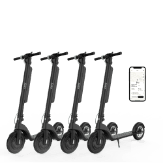
- Identification: Chargers use company app (Bird Charger app, Lime Juicer app) showing map of scooters with low batteries needing collection
- Collection: Chargers drive around city in evening collecting depleted scooters (typically those below 20% battery)
- Transport home: Chargers load scooters into personal vehicles (cars, trucks, vans) and bring to residence
- Overnight charging: Chargers plug scooters into home outlets, charging 4-10 units overnight using personal electricity
- Morning redeployment: Chargers return fully-charged scooters to high-demand areas (downtown, transit stops, business districts) before 7am deadline
- Payment: Chargers earn $3-12 per scooter depending on difficulty (location, battery level, time of year), paid via app
Charger/Juicer Economics
Earnings potential for independent chargers:
- Per scooter rate: $3-5 for easy pickups (accessible locations, moderately depleted), $8-12 for difficult pickups (remote locations, completely dead batteries)
- Charging capacity: Most chargers handle 3-10 scooters per night (limited by outlet availability and vehicle capacity)
- Nightly earnings: $30-120 depending on number of scooters and difficulty
- Electricity cost: $0.50-2 per night for charging 5-10 scooters (minimal compared to earnings)
- Time investment: 2-4 hours evening collection, 1-2 hours morning deployment = 3-6 hours work
- Hourly equivalent: $10-30/hour depending on efficiency
Requirements to become charger:
- Vehicle capable of transporting multiple scooters (SUV, truck, van ideal)
- Smartphone with company app
- Multiple outlet access at home (3+ outlets for efficient charging)
- Physical ability to lift/move scooters (40-50 lbs each)
- Availability during collection windows (6pm-midnight) and deployment windows (5am-7am)
- 18+ years old in most markets
Swappable Battery Systems
Some rental operators use battery-swap model instead of whole-scooter charging:
How battery swapping works:
- Scooters designed with quickly removable batteries (30-second swap time)
- Company workers or contractors carry pre-charged batteries in vehicles
- Workers swap depleted batteries for charged ones in the field (no scooter transport needed)
- Depleted batteries returned to central charging facility for professional charging
- Much faster than whole-scooter collection (can service 30-50 scooters in time it takes to collect 10)
Operators using battery-swap systems: Lime (experimenting in select markets), Gogoro (Taiwan scooter-share leader), Tier Mobility (European operator), Niu (China).
Advantages: Faster servicing, no need to transport heavy scooters, reduced vehicle requirements for operations, professional charging facilities enable better battery management.
Disadvantages: Higher upfront cost (swappable battery design more expensive), requires extensive battery inventory (2-3× batteries vs. scooters), theft risk (removable batteries attractive to thieves), requires charging facility infrastructure.
Future of Electric Scooter Charging Infrastructure
As micro-mobility grows, dedicated charging infrastructure continues evolving.
Emerging Charging Solutions
- Dedicated scooter charging hubs: Racks with integrated charging for 10-50 scooters, similar to bike-share docking stations, emerging in European cities (Amsterdam, Paris, Barcelona)
- Curbside charging stations: Streetside installations providing charging for personally-owned scooters parked at public racks
- Wireless/inductive charging: Park scooter on charging pad without plugging in, technology demonstrated but not yet widely deployed
- Solar-powered charging stations: Self-sufficient stations using solar panels + battery storage, ideal for parks and remote areas
- EV charging integration: New EV car charging stations including micro-mobility outlets as standard feature
- Employer charging incentives: Tax credits or utility rebates for businesses installing workplace micro-mobility charging
Policy and Infrastructure Trends
- Building code requirements: Some progressive cities (Portland, Austin) now require new commercial construction to include micro-mobility parking and charging
- Public infrastructure investment: Federal infrastructure bills increasingly include micro-mobility as eligible use for transportation funding
- Standardization efforts: Industry working toward universal charging connector standards (currently most scooters use proprietary connectors)
Conclusion: Charging Strategy for Every Situation
Successful electric scooter ownership requires matching charging strategy to usage pattern. For most riders, home charging provides primary solution (convenient, low-cost at $0.03-0.15 per charge, controls charging environment), supplemented by opportunistic workplace charging for extended-range commutes (doubles viable commute distance with midday charge), occasional cafe top-offs during errands (one hour = 5-8 additional miles), and emerging public charging infrastructure in progressive cities (still limited but growing rapidly).
Key charging strategy takeaways:
- Establish home charging routine—charge overnight using dedicated garage/utility room outlet, install timer for automatic disconnection after 6-10 hours, keep charging area on non-flammable surface with ventilation
- Request workplace charging if commuting beyond half-range—approach employer with cost analysis ($20-40 annual electricity), propose specific charging location, follow workplace etiquette to maintain privilege
- Map public charging along regular routes—use PlugShare and ChargePoint apps to identify backup charging, verify availability before depending on public charging for critical trips
- Practice cafe charging courtesy—ask permission, make genuine purchase, limit to 1-2 hours, position scooter safely out of walkways
- Consider portable power for off-grid adventures—500-1,000Wh power station provides charging independence for camping/van life ($500-1,000 investment)
As micro-mobility infrastructure matures over the 2020s, public charging will become as ubiquitous as EV car charging, but until then, successful scooter riders develop multi-location charging strategies ensuring they're never stranded with depleted battery.