






Running two batteries in parallel: what actually happens
Adding a second battery to an e-bike or scooter is one of the most common questions in light electric vehicles, and one of the most commonly answered badly. Here is the physics, honestly, and the four ways manufacturers actually solve it.
The problem is a voltage difference, not a wiring mistake
A lithium pack is a voltage source with very low internal resistance. That is what makes it good at moving a vehicle, and it is also what makes paralleling two of them delicate. Take two 52 V-class packs where one is nearly full and the other is half-empty. There is a real potential difference between them — several volts is entirely normal.
Connect them and that difference appears across nothing but the resistance of your wiring, your connectors, and the packs’ own internal resistance. All of those are deliberately small. The resulting current is not a design choice; it is what Ohm’s law requires given the numbers involved, and it appears the instant the contacts touch.
What that current does depends on your luck. A BMS may see an over-current condition and open. A connector may arc as it makes contact, leaving pitting that raises resistance for the rest of its life. Or nothing visible happens at all, which is the outcome that convinces people it is fine — right up until the packs have drifted further apart.
Worth being clear about: packs that are genuinely matched — same model, same age, charged together, connected at the same state of charge — can be paralleled directly, and plenty of people do it without incident. The problem is not that it never works. The problem is that it depends on conditions a rider has to maintain forever, and a product cannot be built on that assumption.
Matched packs do not stay matched
Even if two packs start identical, they do not age identically. Cells drift with temperature history, depth of discharge, and simple manufacturing spread. A pack that lives in a hot stem ages differently from one in a shaded deck. After a season, the two packs have different usable capacities and different internal resistances, so they no longer share current evenly — the lower-resistance pack takes more than its share, which ages it faster, which widens the gap.
This is why the interesting engineering question is not “can I connect two packs today” but “what does this system do in year three.”
“Dual battery” does not mean one thing
This is the part almost everyone gets wrong, including people selling the hardware. A product badged “dual battery” or even “parallel module” can be doing any of three quite different things:
True parallel
Both packs source current simultaneously by default. Specialized documents its SL Range Extender this way — the internal battery and the extender discharge together unless you tell the app otherwise.
Managed hybrid
The fuller pack is discharged alone until the two converge, then both run together. Bosch describes its DualBattery system in these terms, with charging mirroring the logic in reverse.
Alternating / switched
Only one pack is ever connected; the system switches when it detects a charge difference. Riese & Müller — who ship bikes using Bosch’s dual-battery hardware — describe the behaviour as the packs being discharged alternately and never simultaneously, switching at around a five percent delta.
Those last two descriptions look contradictory, and the confusion is worth untangling because it comes up constantly. The resolution is that “parallel” gets used two ways: marketing copy describes the parallel use of two batteries, while the technical sections describe the actual electrical behaviour, which is switched. Bosch’s own battery documentation says the system switches between the two batteries during both charging and discharging.
We should be careful about how firmly that can be asserted from outside. Published charge times are sometimes offered as proof of sequencing, but they do not settle it: one charger of fixed output takes roughly twice as long to put in twice the energy whether it fills the packs one after another or both together. The vendor’s own wording is the better evidence, and the honest position is that the public record on this is thinner than the confident claims made about it.
That distinction has a consequence people miss. A switched system gives you twice the energy but not twice the power, because only one pack is ever delivering current. If your reason for going dual-pack is range, switching is fine. If it is peak current — a cargo bike on a hill, a heavier vehicle, a higher-power motor — switching does not help you at all, and only a genuinely parallel architecture does. So the useful question for a supplier is not “is it parallel” but “can both packs deliver current at the same time.”
The distinction matters because the three architectures behave differently in the cases you actually care about: whether removing a pack interrupts power, whether a weak pack drags down a strong one, and — if you ever want regenerative braking — which pack the returning current is allowed to go into.
Four ways to combine two packs
Direct parallel wiring
Not recommended for a productA splitter cable and nothing else. Common in retrofits and forum builds. Depends entirely on the rider always keeping both packs matched and charged together, which is not an assumption you can ship to consumers.
Passive diode isolation
Safe but lossyA diode in each pack path stops the packs back-feeding each other. Simple and genuinely safe, but every amp of vehicle current pays a forward voltage drop, and that becomes continuous heat inside a sealed enclosure. It also means the packs cannot be charged through the same path they discharge through without extra care.
Manual A/B switching
Works, poor experienceRun one pack at a time and switch when it runs down. Avoids the paralleling problem entirely by never actually paralleling. The rider has to manage it, and you get none of the benefit of a combined bus, such as a lower average discharge rate per pack.
Active combining circuit
What production vehicles useEach pack gets its own actively controlled low-loss path onto a shared bus. Mismatched packs converge instead of fighting, either pack can be removed while the vehicle keeps running, and the controller can be told when a pack drops out. More expensive per unit and requires real engineering — which is why it tends to show up in vehicles built at volume rather than retrofits.
If you are specifying this for a vehicle
The questions that actually determine whether a two-pack architecture works out:
- What is the worst-case state-of-charge difference between packs the rider can create, and what happens at that moment?
- Can a pack be inserted or removed while the vehicle is powered — and if a rider does it anyway, what breaks?
- How much power does the combining method itself dissipate at continuous current, and where does that heat go?
- When one pack faults or is absent, does the vehicle know, or does it just lose power?
- Can each pack still be charged behind its own protection, or does the combining circuit bypass it?
We build the fourth option
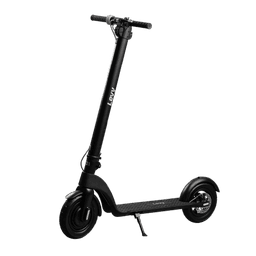
Levy PowerBridge is the power management board in our own scooters — two packs on one traction bus, either one removable mid-ride, each with its own protected charge path. It is in production, and we are making it available to other light electric vehicle manufacturers.
See the boardCommon questions
Can I connect two e-bike batteries in parallel?
Electrically it is possible, but connecting two lithium packs directly is only reasonably safe when they are the same chemistry, same series count, same capacity, similar age, and at nearly the same state of charge. The moment those conditions do not hold, current flows between the packs the instant you connect them. Most manufacturers use a combining circuit rather than a direct connection precisely so those conditions do not have to hold.
What happens if the two batteries are at different charge levels?
The pack at the higher voltage drives current into the lower one. The only things limiting that current are the resistance of the wiring and connectors and whatever the two battery management systems decide to do. That inrush can trip a BMS, weld a connector, or stress cells — and it happens at the connector, before anything in the vehicle sees it.
Do the packs need to be the same capacity?
If they are wired directly together, matching capacity matters because the packs share current in proportion to their internal resistance rather than their capacity, so a smaller pack can end up working harder than it should. With a combiner that gives each pack a controlled path, capacity matching becomes much less critical.
Is it safe to remove one battery while riding?
Only if the electrical system is designed for it. With a direct parallel connection, disconnecting a pack under load breaks the circuit at a connector carrying real current, which is how connectors arc and pit. A system built for hot-swap moves that transition into a switching element designed to handle it.
Does a BMS handle paralleling for me?
No. A BMS protects the cells inside its own pack. It has no visibility into what the other pack is doing and no way to arbitrate between them. Two BMSs connected in parallel are two independent referees with no shared rulebook — which is a different problem from the one a combining circuit solves.
How close in voltage do two packs need to be before connecting them?
If you are wiring them directly together, as close as you can practically get them — the common guidance is a small fraction of a volt, and the reason is arithmetic rather than superstition. Divide the voltage difference by the total resistance of the packs and the wiring between them, and that is your inrush current. With the very low resistances involved, even a volt or two produces a current far higher than anything the system sees in normal use. If you find yourself measuring packs with a multimeter before every connection, that is the real signal: the architecture is asking the rider to do a job the electronics should be doing.
Can I mix a 48V and a 52V battery in parallel?
No — and a combiner does not fix this one. Those nominal labels describe different series cell counts, so the packs have genuinely different full-charge voltages, several volts apart at the top. The nominal ranges overlap in mid-discharge, which is why it sometimes appears to work, but the failure case sits exactly where you least want it. It gets worse if the two share a charger: a supply set for the higher-count pack will drive the lower-count pack past the ceiling its own protection is built to defend. Combining hardware helps with packs that differ in state of charge or capacity — it does not make different series counts safe. Match the series count, then talk about the rest.
Can I charge both packs through the same connection?
It depends entirely on the design, and this is where a lot of simple combiners stop. Several aftermarket modules are explicitly discharge-side only — they let both packs drive the vehicle, but you charge each pack separately. If you want a single charger input feeding both packs, that path needs its own reverse blocking so neither pack can back-feed the other through the charge port, and each pack has to stay behind its own protection. Ask any supplier this question directly; the answer tells you a great deal about how much engineering is actually in the part.